 English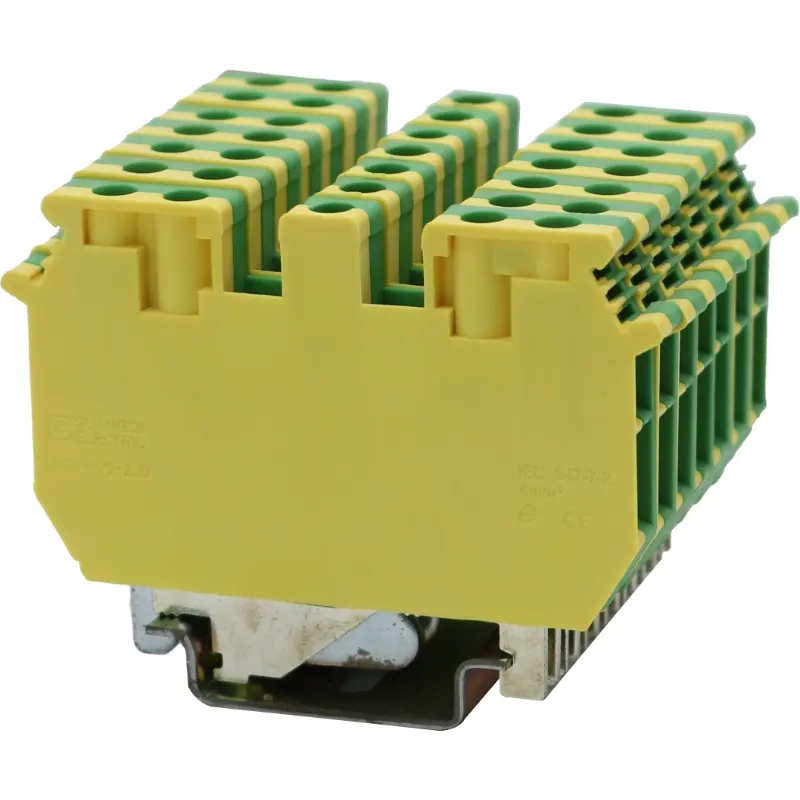
| Terminal thickness: 6.2 | ||||
| Rigid conductor | Flexible conductor | I | Ui | |
| (mm2) | (A) | (V) | ||
| IEC 60947-7-2 | ||||
| 0.2-6 | 0.2-4 | |||
| Description | Color | Type | |
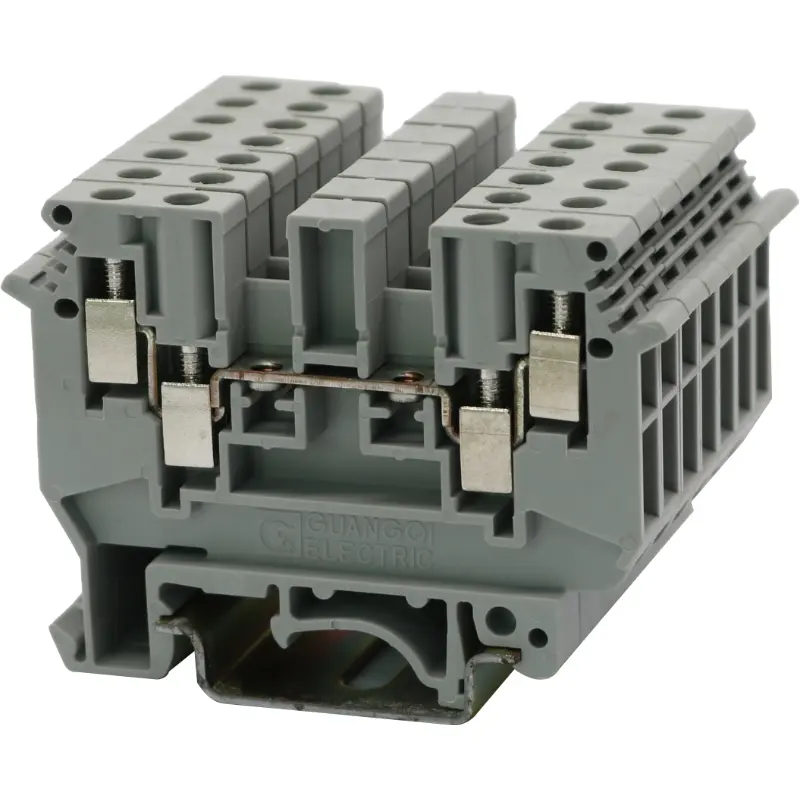
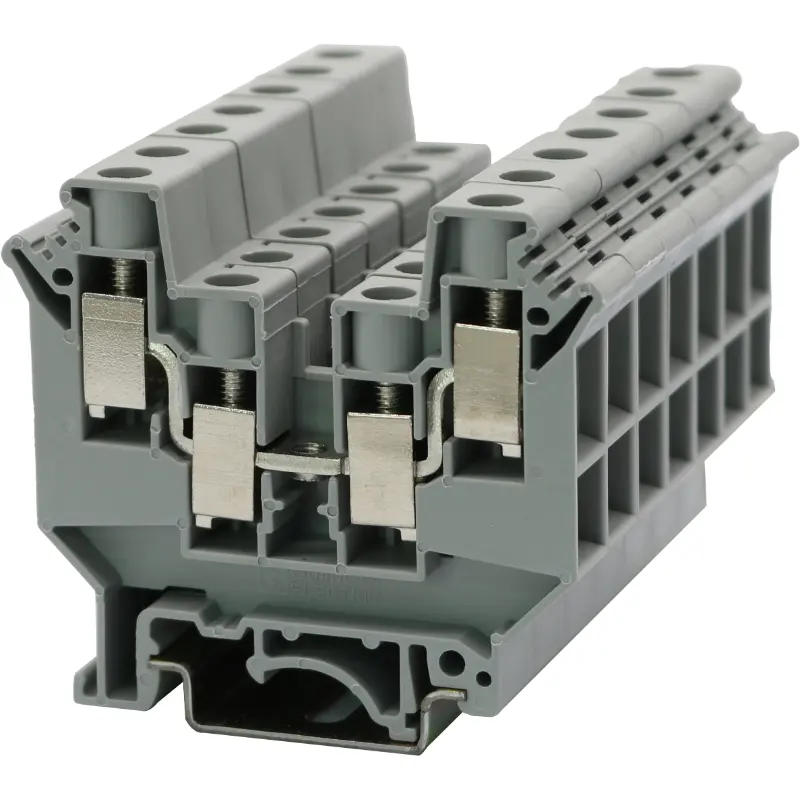
| Terminal: With general-purpose locating base, suitable for standard mounting rails | Grey | ||
| Blue | |||
| Ground terminal: The yellow-green insulating housings are suitable for the standard mounting rails | JWD1-4/2-2 JD | ||
| (1) End plate: One additional piece must be attached to the end of each terminal strip set. If it is mounted in the center of the terminal strip, the creepage distance may increase. | Grey | ||
| Blue | |||
| (2) Central liaison part: It is used to connect terminals with the same specification and form a liaison terminal group; each part has 10 digits (supplied with screws) that can be further divided at will. | |||
| (3) Connecting sheet: For central connection of more than 10 digits | |||
| (4) Edge liaison part: Its role is the same as that of the central liaison part (2); with insulation on the back side; 10 digits that can be further divided at will | 2 digits: | BL 6/2 | |
| 3 digits: | BL 6/3 | ||
| 10 digits: | BL 6/10 | ||
| (5) Jumping liaison part: With the spacer (6), it can connect any non-adjacent terminals in the center to form a jumping liaison terminal group. | |||
| (6) Spacer: Used as a spacer block between the accessory of the jumping liaison part (5) and the conductive part of the terminal | |||
| (7) Switch liaison part: To be used on top of the terminal for switch connection; the end plate (1) should be added between the connected terminals to ensure electrical isolation. | |||
| (8) Divider: It is used to separate two adjacent liaison terminal groups and can be inserted after assembly, without any effect on the overall space. | |||
| (9) Tag: It can be quickly inserted in the upper grooves on both sides of the terminal as a whole for any identification. It has a total of 10 digits (to be divided at will). | White | ZP6 |
| Terminal dimensions | ||
| Thickness / width / end plate thickness | [mm] | 6.2/63.5/- |
| Height (TH 35:7.5 / TH 35:15 / G 32:15) | [mm] | 47/54.5/52.5 |
| Technical data based on IEC/DIN VDE standards | ||
| Maximum rated working current / cross-sectional area | [A] / [mm2] | - |
| Maximum cross-sectional area of conductors (rigid / flexible) that can be connected if any edge liaison part is used: | [mm2] | - |
| Rated impulse withstand voltage / degree of pollution | [kV]/- | 45507 |
| Over-voltage category / insulation material group | -/- | lll/l |
| Connection capacity of feed-through layer | ||
| Flexible conductor with tubular bare terminal / tubular pre-insulated terminal | [mm2] | 0.254 / 0.25-1.5 |
| Feed-through layer: connecting two conductors with the same cross-sectional area) | ||
| Rigid conductor / flexible conductor | [mm2] | 0.2-1 /0.2-1.5 |
| Flexible conductor with tubular bare terminal | [mm2] | 0.25-1.5 |
| Flexible conductor with DEV-tubular pre-insulated terminal | [mm2] | 0.5- 1.5 |
| Stripping length | [mm] | 8 |
| Screw for terminal position: screw type / torque | M 3/0.6-0.8 | |
| Central fastening screw: screw type / torque | [Nm] | M 3/0.6-0.8 |
| Insulation material type | PA | |
| Material flammability according to UL94 | V0 | |
| Rated working voltage / rated working current / wire gauge | UL: [V]/[A]/AWG | -/-/30-10 |
| Note: When an edge liaison part is used, a cable below 1.5 mm2 should be used for a 2.5 mm2 terminal; corresponding cables should be used for terminals with other cross-sectional areas (mm2). | ||








Welcome to consult us for more information!