


In the competitive landscape of 2026, electrical cabinet builders and system integrators are facing a common challenge: skyrocketing labor costs and a shortage of skilled technicians. Every minute saved on the assembly line directly impacts the project’s bottom line.
While the traditional Screw Connection has been the industry workhorse for decades, Push-in Technology is rapidly becoming the standard for modern automation. But which one truly saves more money when you factor in the total cost of ownership? Let’s break down the data.
1. Installation Speed: The 50% Efficiency Rule
The most immediate difference between the two technologies is the time spent per wire termination.
- Screw Connection: Requires a technician to strip the wire, insert it, hold it in place, and manually torque the screw to the correct specification. This process is repetitive and prone to fatigue-induced slowness.

- Push-In Technology: As the name suggests, solid wires or wires with ferrules are simply pushed into the terminal point. There are no screws to turn and no torque tools required.
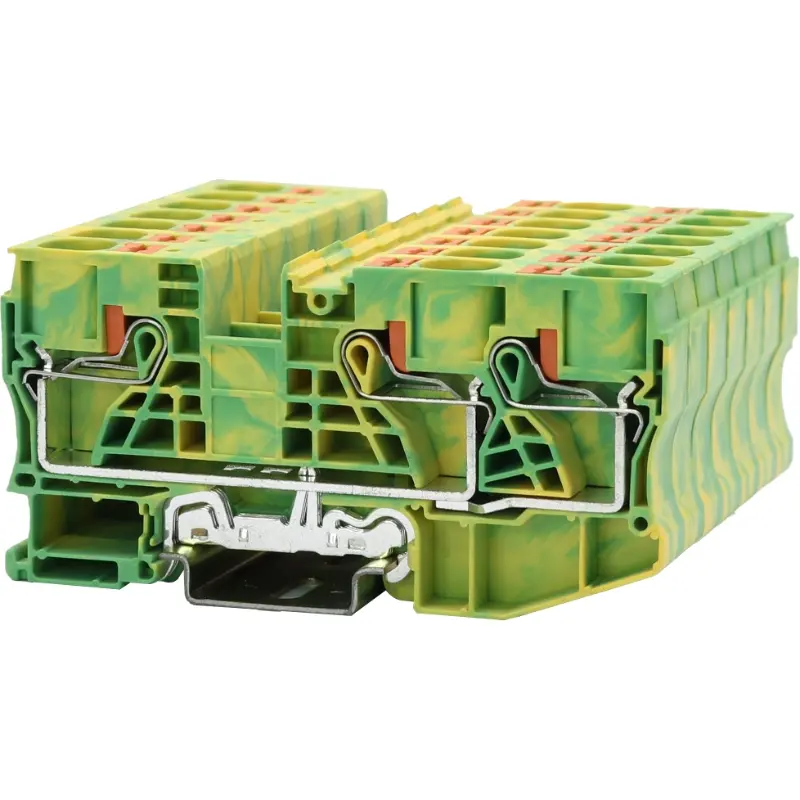
The Verdict: Field studies in 2026 show that Push-in Terminal Blocks can reduce wiring time by up to 50% to 70% compared to traditional screw clamps. For a control cabinet with 500+ termination points, this translates to hours of saved labor.
2. Maintenance and Long-Term Reliability
Labor costs aren’t just about the initial build; they also include maintenance and warranty calls.
- The “Loose Screw” Problem: Over time, vibrations in industrial environments or thermal expansion/contraction can cause screws to loosen. This necessitates periodic “retightening” maintenance schedules—a significant hidden labor cost.
- Vibration-Proof Security: Push-in terminals utilize a high-tension spring mechanism that applies constant pressure on the conductor. This connection is inherently vibration-proof and gas-tight.
The Verdict: Once a Push-in terminal is installed, it is maintenance-free for its entire lifecycle. This eliminates the need for expensive on-site maintenance visits.
3. Human Error and Training Costs
In 2026, relying on “technician intuition” for screw torque is a risk. Under-tightening leads to arcing and fires, while over-tightening can damage the wire or the terminal block itself.
- Standardization: Push-in technology removes the human variable. The spring pressure is factory-set, ensuring a perfect connection every time, regardless of the operator’s skill level.
- Training: New employees can be trained to use Push-in systems in minutes, reducing the “onboarding” time for your assembly team.
4. Space and Tooling Efficiency
Modern GKoncy DIN Rail Terminal Blocks are designed to be more compact. Push-in models often allow for higher wiring density. Additionally, because no screwdrivers are needed for the initial connection, tool wear-and-tear and the risk of “dropped screws” inside a live cabinet are eliminated.
The ROI Calculation: Is the Upgrade Worth It?
While Push-in terminal blocks may have a slightly higher unit price than basic screw terminals, the Total Labor Savings tell a different story:
| Feature | Screw Connection | Push-In Connection |
| Wiring Speed | Slow (Manual) | Fast (Instant) |
| Tooling Needed | Torque Screwdriver | None |
| Vibration Resistance | Requires Retightening | Maintenance-Free |
| Human Error Risk | High (Torque variance) | Minimal |
| Total Labor Cost | High | Low (Saves ~50%) |
Conclusion: Making the Strategic Choice
For high-volume production and critical infrastructure in 2026, the shift to Push-in technology is no longer optional—it is a financial necessity. By reducing assembly hours and eliminating long-term maintenance, Push-in terminals offer a significantly lower Total Cost of Ownership.
At GKoncy, we provide a comprehensive range of both technologies, but our Advanced Push-In Series is specifically engineered for the demands of the modern smart factory.
Ready to accelerate your production? Explore the GKoncy Terminal Block Catalog or contact our engineers for a custom cabinet wiring audit.