


Industrial environments characterized by continuous mechanical stress and high-frequency oscillations present unique challenges for electrical panel builders. In sectors such as railway transportation, wind energy generation, and heavy-duty manufacturing, the reliability of electrical connections is constantly under threat. A single loose wire can trigger catastrophic system failures, leading to expensive maintenance downtime and severe safety hazards. This makes the selection of internal panel components a critical engineering decision, not just an afterthought.
At the heart of these control panels lie DIN rail terminal blocks, the essential hubs that organize and secure complex wiring systems. However, not all connection technologies are engineered to withstand rigorous kinetic forces. When subjected to prolonged shaking or sudden impacts, traditional wiring methods often experience a gradual loss of clamping force. This structural degradation increases contact resistance, resulting in localized overheating and potential electrical fires.
To mitigate these risks, engineers must evaluate the mechanical holding power of different terminal types. By comparing traditional screw-type clamps with modern spring-loaded mechanisms, panel designers can identify the most resilient solutions. Understanding how specific connection technologies behave under constant mechanical stress is the key to ensuring long-term operational stability.
The Physics of Wire Loosening Under Vibration
When electrical enclosures are mounted on vibrating machinery, the internal wiring undergoes continuous micro-movements. These microscopic shifts cause the copper conductors to experience cold flow—a phenomenon where the metal gradually deforms and yields under sustained pressure. Over time, this deformation relaxes the clamping force originally applied during installation.
Furthermore, thermal cycling—the expansion and contraction of metals due to temperature fluctuations—compounds the effects of vibration. When machinery heats up during operation and cools down at rest, the connection points expand and contract. This combination of thermal and kinetic stress rapidly accelerates the loosening process in rigid connection systems. If the connection point lacks the ability to dynamically compensate for this material shifting, the interface becomes compromised. This is the exact reason why standard commercial DIN rail terminal blocks often fail in heavy-industrial applications.
Screw vs Spring: Analyzing Connection Technologies
To solve the vibration problem, we must analyze the structural differences between the two most prominent connection methods used in control panels today.
The Limitations of Traditional Screw Connections
Screw-type terminals have been the industry standard for decades, prized for their ability to handle massive wire cross-sections and high current loads. The operator applies torque to a screw, which drives a clamping yoke down onto the conductor. However, in high-vibration scenarios, this static connection is a critical vulnerability. The threads of the screw can slowly back out due to constant kinetic energy. Unless equipped with specialized anti-loosening designs or paired with extremely strict maintenance schedules for retightening, standard screw terminals are fundamentally ill-suited for heavy oscillation.
The Dominance of Spring-Cage Technology
For environments where shaking and impacts are inevitable, spring-cage designs are the superior choice. Instead of relying on static torque, a pre-stressed stainless steel spring applies constant, dynamic pressure against the wire. As the copper conductor experiences cold flow or subtle movements from vibration, the spring automatically adjusts, maintaining a permanent, gas-tight connection. These vibration-proof terminal blocks completely eliminate the need for routine retightening, significantly reducing maintenance costs and eliminating the risk of human error during installation.
Why Engineers Trust GKONCY in Harsh Environments
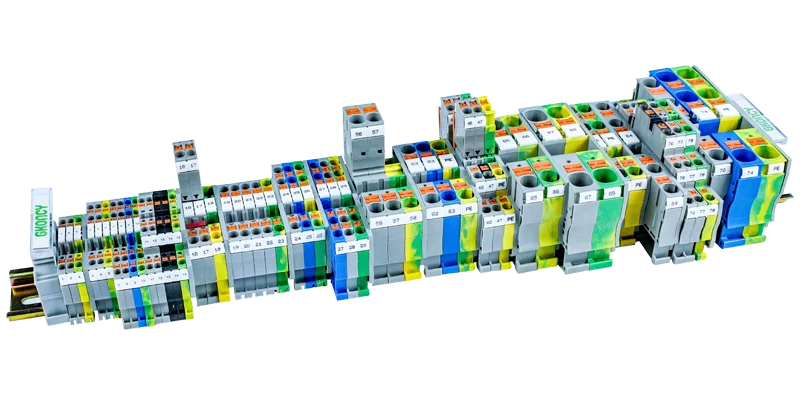
Selecting the right component requires partnering with a manufacturer that understands extreme industrial demands. GKONCY has engineered its product lines specifically to combat the challenges of mechanical stress. The metal bodies inside GKONCY terminals are crafted from premium copper alloys, ensuring optimal conductivity while resisting corrosion.
More importantly, GKONCY’s spring-cage designs have undergone rigorous shock and vibration testing to meet stringent international standards, including UL and CE certifications. Their dynamic clamping mechanisms guarantee that the pull-out force remains exceptionally high, even after years of continuous operation in railway or wind turbine applications. Whether you are designing a compact control cabinet for a robotic assembly line or a heavy-duty distribution board for marine engineering, GKONCY provides specialized solutions tailored to your operational realities. Their intuitive variants offer tool-free installation, cutting wiring time while guaranteeing a secure hold.
Conclusion: Future-Proofing Your Control Panels
When designing for harsh kinetic environments, the battle is won or lost at the connection points. Transitioning away from traditional static clamping towards dynamic, self-adjusting technologies is an engineering necessity. By specifying high-quality spring-cage DIN rail terminal blocks, panel builders can ensure safety, optimize efficiency, and deliver automation systems that withstand the test of time and vibration.